
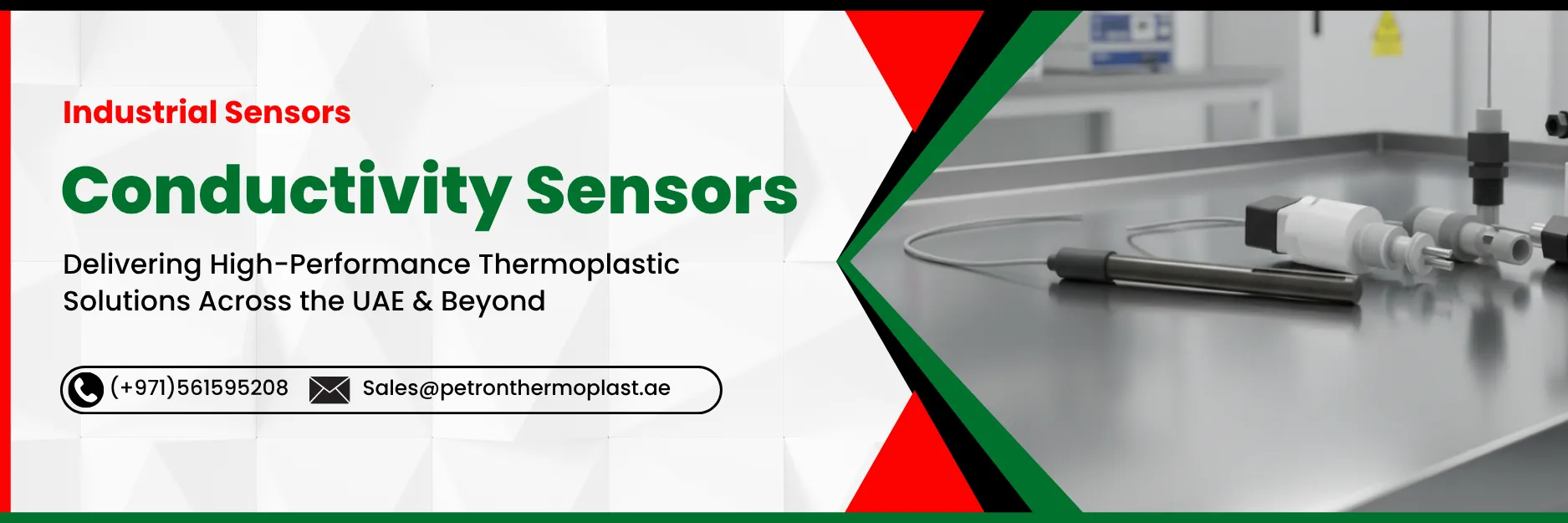
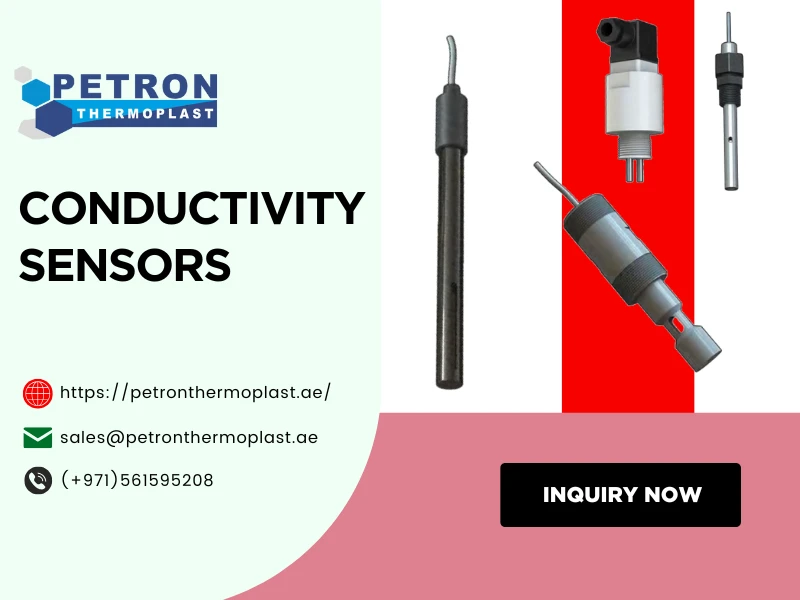
Conductivity Sensors Banner images
Conductivity Sensors main page Graphics

Industrial Sensors In UAE

Conductivity Sensors

Accurate measurement of fluid conductivity is essential in industries ranging from water treatment and chemical processing to pharmaceuticals and food production. At Petron Thermoplast FZ LLC, UAE, we provide advanced Conductivity Sensors designed for real-time monitoring and precise control of solution concentration, ionic purity, and contamination levels.

Built with robust materials and cutting-edge technology, our conductivity sensors help industries in the UAE and across the Middle East maintain process integrity, optimize chemical usage, and comply with regional and international quality standards. Whether you require inline, submersible, or sanitary designs, we have solutions for diverse industrial applications.

More About

What Are Conductivity Sensors?

Conductivity sensors measure a liquid’s ability to conduct an electric current — a property determined by the concentration of ions (salts, acids, or bases) in the fluid. The higher the ion concentration, the greater the conductivity.

Common uses include:

Features of Sensors

Key Features of Our Conductivity Sensors
1
Wide Measurement Range
From ultrapure water (0.055 µS/cm) to high-concentration industrial solutions (up to 2000 mS/cm)
2
Integrated Temperature Compensation
Ensures accurate readings under varying process conditions
3
Corrosion-Resistant Materials
Stainless steel, PVDF, PEEK, or Teflon for aggressive chemical media
4
Easy System Integration
Analog (4–20mA), digital (Modbus, HART), or relay outputs
5
Robust Housing Options
Inline, insertion, sanitary, or submersible models
6
Low Maintenance
Especially with inductive/toroidal sensor designs

Applications

Applications of Conductivity Sensors
IndustrySpecification
Water & WastewaterTDS monitoring, desalination, leak detection, and effluent compliance
Chemical ManufacturingProcess control, concentration measurement, batch consistency
Food & BeverageCIP validation, brine monitoring, quality control
PharmaceuticalsUltrapure water monitoring, cleaning verification
Power GenerationBoiler feed water, cooling tower conductivity control
SemiconductorDeionized water monitoring for electronics production

Applications

What industries use Particle Sensors?
repair-tools

Cleanroom manufacturing

quality

Environmental monitoring

flexibility

HVAC and air purification systems

fast-food

Food and beverage production

teamwork

Automotive and electronics industries

chemicals

Hospitals and laboratories

WHy Choose us

Why Choose Petron Thermoplast FZ LLC?
premium

Comprehensive Range

From basic TDS monitoring to advanced multi-parameter conductivity analysis.

reputation

Custom Solutions

Mounting type, range, and material tailored to your process.

organization

Built for Harsh Environments

Designed for high temperatures, aggressive chemicals, and demanding industrial settings.

live-chat

Expert Technical Support

Pre-sales consultation, installation guidance, and lifetime service.

fast-delivery

Fast Delivery Across UAE & GCC

Strong regional logistics for quick supply and support.

Conclusion

Accurate and reliable conductivity measurement is critical for quality control, efficiency, and compliance in industrial operations. Whether for ultrapure pharmaceutical water, industrial chemical processes, or wastewater management, Petron Thermoplast FZ LLC delivers sensors that ensure precision and durability.

Our conductivity sensors are engineered to provide dependable performance, withstand harsh conditions, and integrate seamlessly with modern automation systems. Backed by technical expertise and tailored solutions, we help industries across the UAE and the Middle East achieve better process control and operational excellence.

Frequently Asked Questions

A device that measures a liquid’s electrical conductivity, indicating ion concentration, purity, or contamination level.

  • Contacting: Electrodes touch the fluid — best for clean or low-conductivity applications.

  • Inductive/Toroidal: No direct contact — ideal for dirty, corrosive, or high-conductivity fluids.

Conductivity sensors are widely used in:

  • Water & wastewater treatment
  • Chemical and pharmaceutical manufacturing
  • Food & beverage industries
  • Power plants and boiler systems
  • Electronics and semiconductor industries

Conductivity is typically measured in:

  • MicroSiemens per centimeter (µS/cm) for low-conductivity fluids
  • MilliSiemens per centimeter (mS/cm) for higher concentrations

Yes, conductivity sensors can indirectly measure TDS using a conversion factor. TDS is calculated by multiplying conductivity (in µS/cm) by a factor (typically 0.5 to 0.7), depending on the composition of the solution.

For best accuracy, calibration is recommended every 6 to 12 months, depending on the application and sensor exposure. Regular maintenance ensures stable performance and compliance with industry standards.

Yes. Petron Thermoplast offers conductivity sensors made from corrosion-resistant materials like PVDF, PEEK, Teflon, and stainless steel, suitable for high-temperature and aggressive chemical environments.

Absolutely. Our sensors offer standard outputs such as 4–20mA, Modbus RTU, RS485, and HART, allowing seamless integration with PLC, SCADA, and IoT control systems.

Yes. Our team at Petron Thermoplast provides pre-sales guidance, installation assistance, and after-sales technical support to ensure optimal sensor performance in your application.